

Pier Luigi Nervi
Sondrio, 1891 – Rome, 1979
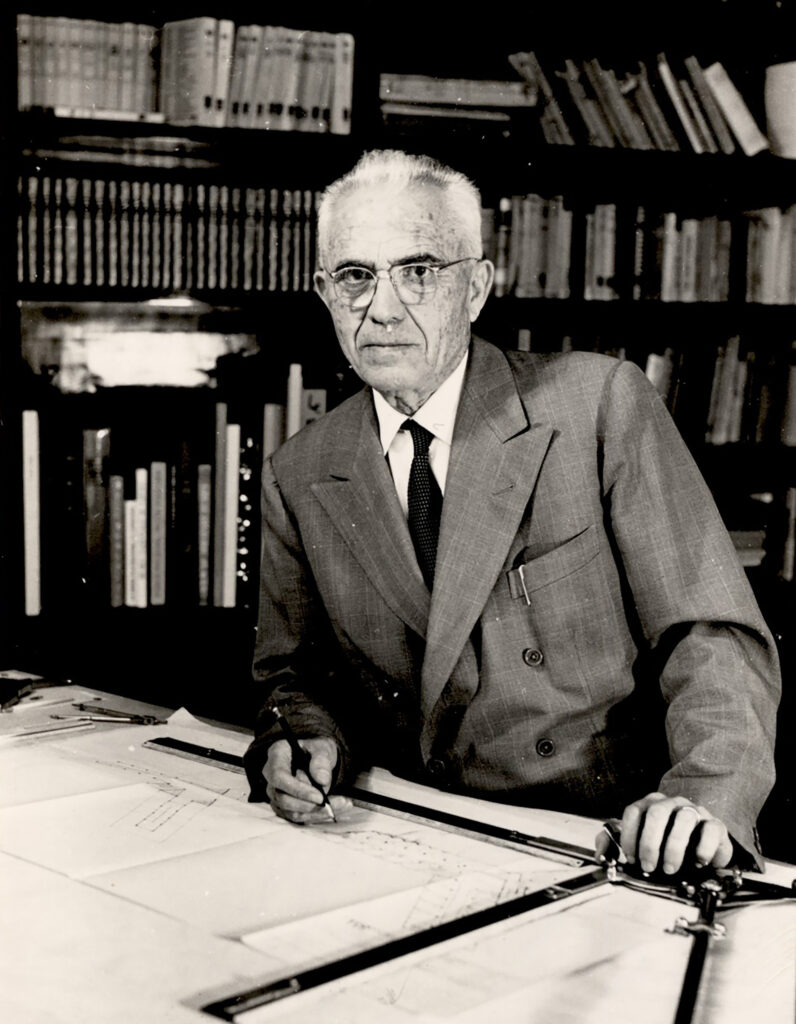
An extraordinary designer, theorist, lecturer, builder, and entrepreneur, he was undoubtedly one of the protagonists of 20th-century architecture and engineering.
From the very beginning, his research was marked by innovative experimentation with the constructive and expressive possibilities of reinforced concrete, of which he became one of the most famous and admired interpreters worldwide. One of the key factors of his extraordinary success is precisely his ability to invent new forms and new ways of building them, through an original and unique system based on the combined use of two instruments of his invention: structural prefabrication and iron-ore cement.
After graduating in Civil Engineering in Bologna in 1913 and a long experience with the Società Anonima per Costruzioni Cementizie, the work that brought Nervi into the national limelight was the ‘Giovanni Berta’ municipal stadium in Florence (1929-1932), followed by innovative and original projects such as the floating hotel (with R. Magnani, 1932-1933) and the revolving house (1934) and the hangars built for the Italian Air Force in Orvieto, Orbetello and Torre del Lago (1935-1938 and 1939-1942).
After World War II, he realised a series of works that consolidated his reputation in Italy and abroad as a brilliant designer and skilful builder, characterised by the extraordinary ‘ribbed’ roofs that his construction company, Ingg. Nervi & Bartoli: the Salone B (1947-1949) and Salone C (1950) of the Turin Exhibition, the Manifattura Tabacchi (Tobacco Factory) in Bologna (1951-1952), the Palazzo del Lavoro (Palace of labour) in Turin (with Gino Covre, 1959-1961) and above all the installations for the 1960 Olympic Games in Rome, which television made known and were admired all over the world.
The exponential growth in international notoriety coincided with the foundation of Studio Nervi in the 1950s, which saw the architect, together with his sons Antonio, Mario and Vittorio and numerous collaborators, working as a designer or structural consultant in every part of the globe, starting with the Unesco headquarters in Paris (with M. Breuer and B. Zehrfuss, 1952-1958) and then, just to name a few of the most important works, the George Washington Bus Station in New York (1960-1962), the Tour de la Bourse in Montreal (with L. Moretti, 1962-1966), the Italian Embassy in Brasilia (with A. Nervi, 1969-1973), the Australia Towers in Sydney (with H. Seidler, 1964), the Vatican Audience Hall (1964-1971), St. Mary’s Cathedral in San Francisco (with P. Belluschi, Mc Sweeney, Ryan & Lee, 1966-71), the project for the bridge over the Strait of Messina (1969).
An extraordinary series of works that, although very different from each other and placed in heterogeneous cultural and technological contexts, are united by the constant presence of those formal characteristics, the ‘pleated’ or ‘ribbed’ domes, the shaped or ‘variable section’ pillars, the isostatic ribbed ceilings, that become a unique stylistic feature, Nervi’s ‘architectural signature’ recognised and admired the world over.