

The entrepreneurial history
The start of Pier Luigi Nervi’s professional activity almost seamlessly follows physically, temporally and conceptually his university education at the Regia Scuola di applicazione per ingegneri e architetti of the University of Bologna. He graduated in civil engineering on 28th July 1913 and immediately began working in the Bologna office of his professor Attilio Muggia. The latter combined an extraordinary knowledge of architecture with extensive professional experience and during his studies provided Nervi with the essential foundations to achieve a perfect synthesis between the project and its realisation through complete mastery of construction techniques. Once the university course was over, Muggia involved the promising pupil in his professional activity which was strongly focused on the use of an innovative material such as reinforced concrete was at the time. As early as 1895, Attilio Muggia had purchased the reinforced concrete patent for Italy, developed by François Hennebique in France, and had created the SACC, Società anonima per costruzioni cementizie, in which Pier Luigi Nervi’s career began.
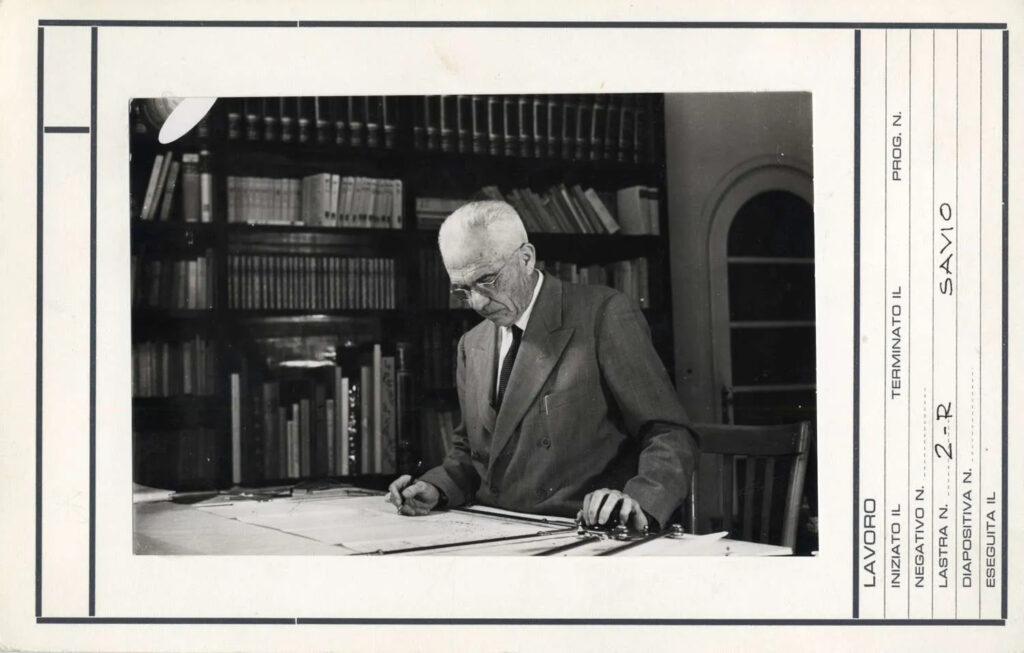
After about a decade, which saw the young engineer and his business also involved in the events of the First World War, Pier Luigi Nervi left SACC, accepting the proposal of association from the Roman entrepreneur Rodolfo Nebbiosi: on 1st June 1923 the Società Ingg. Nervi e Nebbiosi was founded.
The years of association with Nebbiosi were fruitful: in his early thirties Nervi moved to Rome from Florence, where in the meantime he had moved to work in the local SACC office, and began to realise demanding projects for public works of various kinds: cinema-theatres, airplane hangars, industrial plants that allowed him to explore the structural and aesthetic capabilities of reinforced concrete. But it was above all the project for the Giovanni Berta Stadium in Florence in 1930-1933 that marked a turning point in his career, as well as in his design career. In fact, while in most of the projects realised by the Nervi e Nebbiosi Company, the structural component was not yet the absolute and manifest protagonist of the external facade of the works, with the realisation of the Berta Stadium there was a change of approach or rather a maturation – of the times as well as of Nervi’s personal path – which finally allowed a sincere use of reinforced concrete, openly revealing its aesthetic as well as structural potential, without compromising with other more traditional materials or coverings and decorative devices that conceal its true nature.
Obviously, this approach was part of a rapidly spreading phenomenon already rooted throughout Europe, which started with large infrastructures and engineering works, passing through the pioneering work of Auguste Perret or Le Corbusier, and by the 1930s had come to be a true lexicon of modern architecture.
When in 1932 the municipal authorities of Florence decided to entrust the Nervi e Nebbiosi Company with the design of the new stadium and covered grandstands, Nervi was able to demonstrate with solutions as daring in form as they were rigorous in structural calculation his very special genius as an architect, in which rationality is driven by enlightened intuition. The Berta stadium and covered grandstand revealed Nervi to Italian and foreign critics and sanctioned his passage from the circumscribed universe of engineers to that of architecture.
All three connotations that make Pier Luigi Nervi a unique figure in the history of twentieth-century architecture and from which his professional success derives appear already at this stage: he is at the same time engineer, architect, and entrepreneur. The potential of this articulate figure will be expressed more and more clearly in the course of his subsequent career.
This radical change in the design approach also coincided with new entrepreneurial needs that led Nervi, precisely during the construction of the Florence stadium, to interrupt his collaboration with Nebbiosi to partner with his cousin Giovanni Bartoli, also an engineer. In 1932 the Società Ingg. Nervi & Bartoli was established, with headquarters in the building on the Arnaldo da Brescia embankment in Rome, built by Nervi in 1928 to a design by architect Giuseppe Capponi
In terms of management structure, Nervi & Bartoli is an example of ‘family capitalism’. The owner’s authority is undisputed, even though ownership is shared with Bartoli. From this moment onwards, one of the most outstanding entrepreneurial experiences (also on an international level) of Italy in the last century finally took shape. The key to success lies not only in the genius of the engineer, by now proven and universally recognised, but also in an extremely efficient work organisation based on the intimate fusion between the design organisation, Studio Nervi, and the construction organisation, Nervi & Bartoli, thanks to which it is possible to realise new, more economically advantageous construction systems, developed and regularly patented by Nervi during his career.
As we read in the publication covering the company’s first thirty years of activity: ‘Nervi & Bartoli has been the instrument through which it has been able to realise works that can be considered in the vanguard of this modern construction system. A decisive element that has led S.p.A. Ingg. Nervi & Bartoli to be one of the best-equipped Italian companies in the realisation of reinforced concrete works, with the technical organisation at its disposal. In fact, the company avails itself of the collaboration of STUDIO NERVI for the architectural and technical design of its realisations; it also has its own highly specialised technical office for the executive design and calculation.
Thanks to this work organisation, Nervi & Bartoli S.p.A. succeeds in implementing a winning market strategy, based on the offer of a product that combines quality and economy, thanks to a management system of the entire production chain that has no equals in the panorama of Italian construction companies. Three of Nervi’s four sons, Antonio, Mario and Vittorio, were also involved in the design activities of Studio Nervi from the 1950s onwards, as well as numerous and authoritative, collaborators. However, the substantial concentration of power in the hands of the owner and founder of the company and the professional studio, which unquestionably represents a strong factor while Nervi is at the height of his activity, turns into an evident weakness when the reference figure is no longer present. A few months after Pier Luigi Nervi’s death in January 1979, his son Antonio, who was also his closest collaborator, died prematurely, and this entrepreneurial and architectural story, which over more than half a century had created concrete projects on five continents, abruptly came to an end.