

Cantiere Burgo, Management housing
Studio Nervi & Bartoli, Mantua
Management housing, 1961-1962
In conjunction with the project for the Cartiere Burgo (Burgo Paper mill), Pier Luigi Nervi created a series of drawings between 1961 and 1962 showing several small villas designed to house employees and the plant manager. Situated to the northeast of the paper mill and arranged in two rows, as if to form a residential quarter with green spaces and internal pathways, the six single-storey houses were never actually built by the architect.
In 1961 Nervi realised an initial version of the villa for the director in which the rooms on the mezzanine floor were developed around a patio, with a clear division between living and sleeping areas. The entire house rests on a thin square platform, which slightly raises the building from the ground, and contrasts with the imposing projecting flat roof. As can be seen from some of the perspectives created by Studio Nervi, the peculiarity of the director’s villa is the relationship that is established between inside and outside, reinforced not only by the entrance path, but also by the large glass surface that leads, initially, into the hall and, later, into the patio. Similarly, in the standard employee house, the element of the patio can be found again, this time not located in the centre, but is split across the front and back of the house, thus generating a more longitudinal development of the rooms and departing from the square layout of the director’s villa.
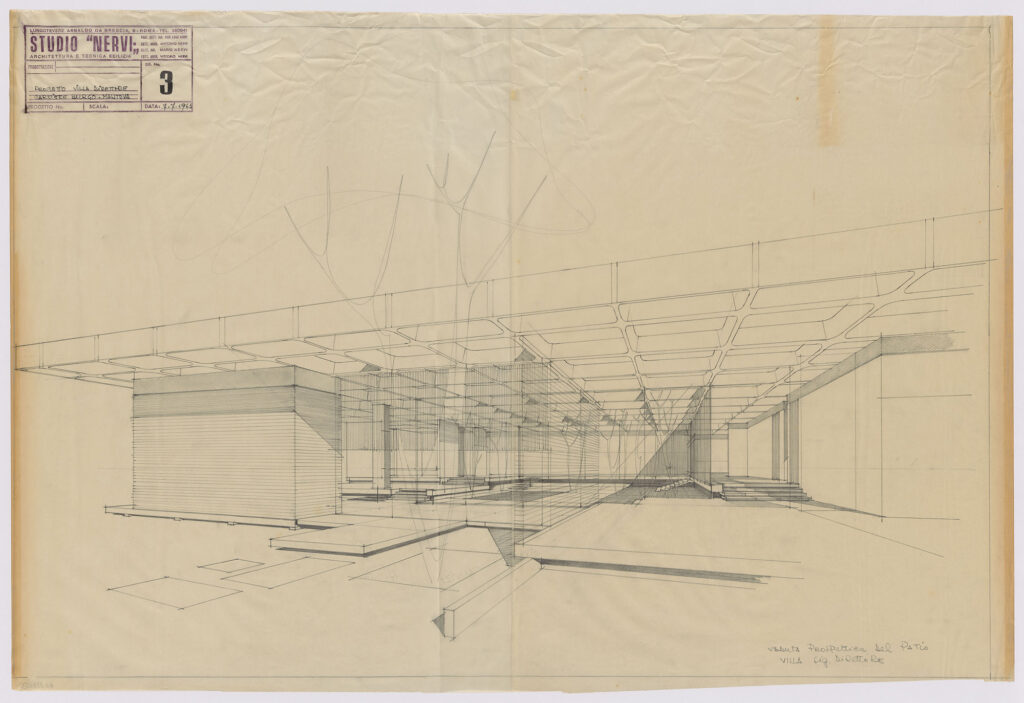
A year later, the design drawings of the director’s villa show a layout that almost completely resembles the five employee’s cottages, except for the larger size due to a greater number of rooms and the amount of green space surrounding the dwelling. Both types of cottages have a brick structure clad in clinker with some reduced portions of the façade decorated with majolica tiles; the entrance, marked by a marble staircase, is raised about 90 centimetres above street level and is marked by a string-course band in grey local stone. In the 1962 version of the director’s villa, following the same procedure for the employees’ cottages, Nervi removes the internal patio and proposes a classical distribution in which the living, sleeping, and service areas are clearly distinguished not only by their location but also by the use of different cladding materials.
The lack of documentation on this project leaves unresolved the question of the actual link that should be established between factory and home, between work and home. Nervi’s small villas are conceived as completely independent structures concerning the great machine of the paper mill; their location within the industrial area relegates the dwellings to a limited lot to the north of the factory, and the architectural and compositional choices adopted do not make the dialogue with the main building immediate.
Cover: ??