

Cartiere Burgo
Studio Nervi & Bartoli (metal structures Gino Covre), Mantua.
General studies, 1960-1964
Cartiere Burgo (Burgo Paper mill), designed in 1960 and completed in 1964, can be counted among the projects of architect Pier Luigi Nervi’s (1891-1979) maturity. Located in Mantua on the shores of Mezzo Lake and announced by a monumental settling tank, the plant stands out as an engineering masterpiece on the national and international scene for its monolithic form and skilful use of structures.
Cartiera Burgo…
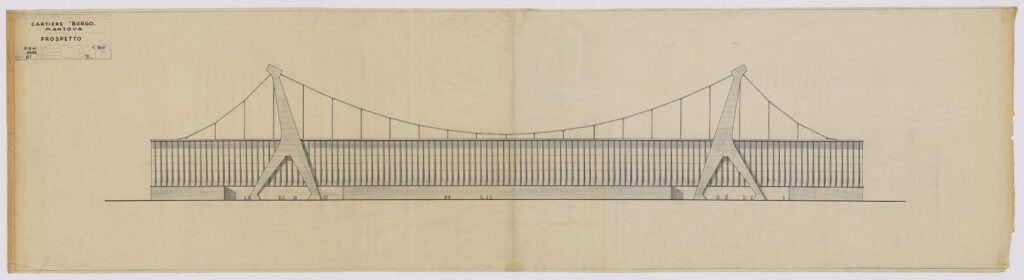
The industrial building, conceived as a suspension bridge in reinforced concrete, covers an area of 250×30 metres, inside which, in a free span of almost 160 metres, houses a machine capable of producing around 300/400 tonnes of paper per day. The structure, which serves not only as a support but also as an enclosure for the machine, is entrusted with the main task of enhancing the innovative character of the paper mill; in fact, the three characteristic elements of the building emerge from the elevation. The reinforced concrete basement, which houses the plant and supports the machine; the steel and glass curtain wall; the suspended roof, whose grid of steel beams is supported by four chains suspended from two imposing 50-meter-high reinforced concrete trestles.
Nervi’s experiments with reinforced concrete and his continuous research into the use of complex configurations can be found in this project in the construction of the roof slab for the paper warehouse. The architect, as attested by some graphic drawings drawn up in August 1961, initially tried to adopt isostatic ribs and finally opted for orthogonal ribs, as shown in the drawings of October of the same year; the result obtained by Nervi was an extremely light structure, with a slab of only 7 centimetres.
The uniqueness of Nervi’s paper mill, not only in the architect’s production, but also in the architectural context in which it is located, is amply reflected in the heated debate that developed around the relationship between engineering and architecture, which reached its peak precisely in those years. Cartiere Burgo is characterised by a strong architectural component, which emerges above all from the successful dialogue between its parts and the continuous aspiration to a unicum, in which form and construction system, as well as building and production process, are closely connected.
Immagine di copertina: ???
Bibliographic reference
A. Galardi, Architettura italiana contemporanea (1955-1965), Edizioni di comunità, Milan 1963, pp. 186-189.
P. L. Nervi, Nuove strutture, Edizioni di comunità, Milan 1963, pp. 164-167.
P. L. Nervi, “Cartiere Burgo a Mantova”, in Edilizia moderna, n. 82-83, 1963, p. 78.
“Usine a Mantoue”, in L’Architecture d’Aujourd’hui, April/May 1964, pp. 163-164.
“Nervi gives a factory the grace of a bridge”, in The Architectural Forum, July 1964, pp. 110-113.
P. L. Nervi, “Cubierta suspendida para una nave industrial, en Mantua (Italia)”, in Informes de la construcción, Vol. 18, n. 174, October 1965, pp. 71-74.
L.G. Marini, P. C. Santini (a cura di), Catalogo Bolaffi dell’architettura italiana: 1963-1966, Bolaffi, Turin 1966, pp. 422-423.
S. Poretti, “Pier Luigi Nervi. Cartiera Burgo, Mantova 1960-1964”, in Casabella, Vol. 61, n. 651-652, December 1997/Gennaio 1998, pp. 96-107.
G. Benedini, Modernità dell’architettura nel territorio mantovano, Tre lune, Mantua 2003.
C. Olmo, C. Chiorino, Pier Luigi Nervi, Architettura come Sfida, Silavana, Cinisello Balsamo 2010.
C. Chiorino, “Mantova, la cartiera Burgo, un capolavoro sospeso”, in Ananke, n. 69, May 2013, pp. 100-103.
D. De Nardi, “Cartiere Burgo: AcciaioArteArchitettura si unisce all’appello per la salvaguardia delle Cartiere Burgo di Mantova di Pier Luigi Nervi”, in Acciaio, Arte, Architettura, n.64, June 2016, pp. 97-98.
R. Gargiani, A. Bologna, The rhetoric of Pier Luigi Nervi. Concrete and ferrocement forms, EPFL Press, Lausanne 2016, pp. 367-372.